Design Guide
Natural Stone: Designing Low Carbon, Long Life Construction
Can Natural Stone Replace Concrete?

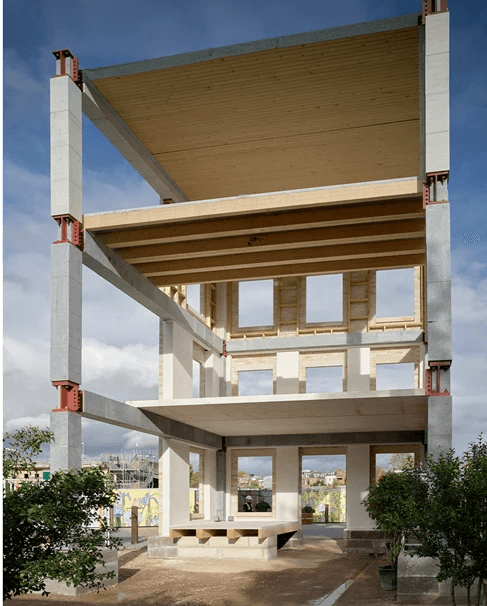
Image Credit: Ivan Jones
Introduction
Embodied carbon is becoming one of the defining challenges shaping how buildings are designed, specified and evaluated. The Embodied Carbon Briefing published by the UK Green Building Council (UKGBC) in 2025 highlights that embodied emissions already account for around 64 million tonnes of CO₂ annually in the UK and are expected to become the dominant source of emissions.
For architects, material selection has a critical role to play. Decisions made during concept design influence not only upfront emissions, but also the durability, adaptability, resource efficiency and long-term value of buildings.
Natural stone offers an opportunity to rethink conventional approaches to low-carbon construction. Unlike energy-intensive materials such as steel, aluminium, concrete and fired clay products, stone requires relatively limited processing. When responsibly extracted, locally sourced and carefully designed, natural stone can provide a lower-carbon alternative with exceptional durability and potential for repair, reuse and recovery.
This requires architects to look beyond the material itself and consider the wider system including how resources are extracted, how quarries are managed, how buildings are constructed, how they age, and what values do they leave behind.
This guide explores how natural stone can be reconsidered not simply as a historic building material, but as part of a regenerative construction system - one that supports long-life buildings, responsible resource stewardship and a more resilient relationship between architecture and the natural world.
Decision Framework
kgCO₂e per tonne - Adjust distance radius in the scale bar below.
Pre-tensioned stone frames sourced locally cut emissions roughly 70% vs reinforced concrete, 90% vs steel
Expected structural service life and weathering behaviour
Depends on installation, maintenance and local climate. Require testings for repurposing.
Sealants, resins, and treatments applied to the stone
Untreated, no VOC coatings or resin fills score best
Stone reads as stone — exposed, load-bearing, not a veneer
Thin-cut cladding over a hidden frame scores lower than true massing
End-of-life route — reuse whole, crush for aggregate, or landfill
Dry-jointed, unglued assemblies score best for future disassembly
Range of spans, forms, finishes the stone type can achieve
Fewer standard sections and details than steel or timber, generally
Suitable for
• Loadbearing masonry • External façades • Rainscreen cladding • Retaining walls • Landscaping • Heritage restoration • Public realm
Design Principles
DESIGN TO MINIMISE IMPACT
Natural stone can support lower-carbon construction when it is responsibly sourced, efficiently used and designed to last. Unlike energy-intensive materials requiring high-temperature manufacturing, stone requires relatively limited processing.
Avoid disposable approaches where valuable stone becomes difficult to recover, such as overly complex assemblies or thin cladding systems that combine multiple materials.
WORK WITH LOCAL MATERIAL ABUNDANCE
Natural stone can strengthen the connection between architecture and place when it is sourced from appropriate local and regional resources. Understanding the material landscape around a project can help reduce transport impacts while supporting local knowledge, skills and economies.
Avoid treating stone as a generic imported finish. Consider how geology, landscape and local expertise can shape contemporary architecture.
DESIGN FOR LONG LIFE AND FUTURE VALUE
Natural stone’s environmental value comes from its ability to endure across generations. Designing for longevity allows buildings to retain material value beyond their initial use.
Avoid designing buildings where valuable materials become inaccessible at the end of their first life. Treat stone as a long-term resource that can support future construction.
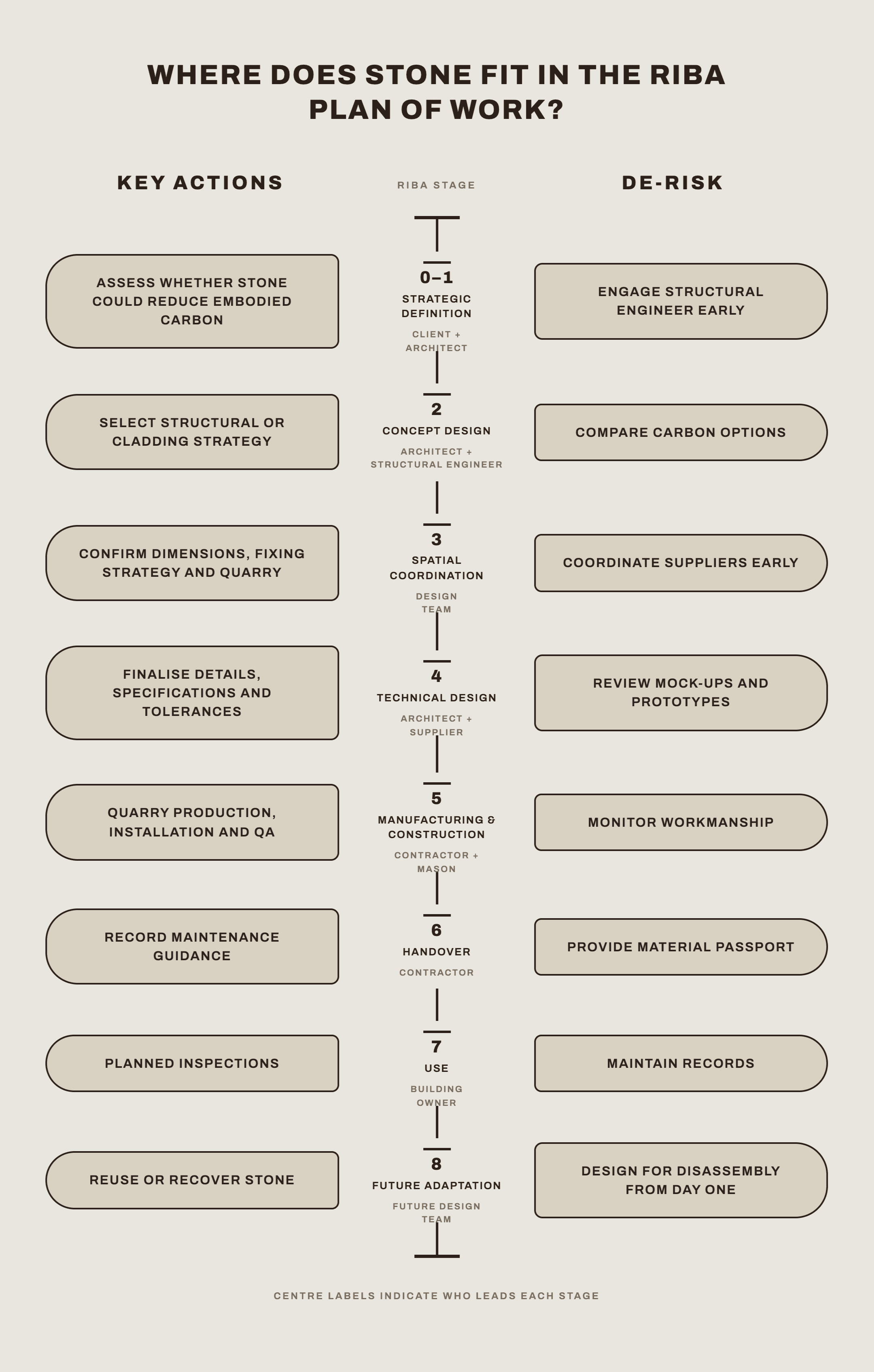
Plan of Work Alignments