undefined min read

undefined min read

undefined min read

undefined min read

Low-Impact Co-Living Home in a Protected Woodland.

The Seed.

Low-Impact Co-Living Home in a Protected Woodland.

Low-Impact Co-Living Home in a Protected Woodland.

Low-Impact Co-Living Home in a Protected Woodland.

Low-Impact Co-Living Home in a Protected Woodland.

Low-Impact Co-Living Home in a Protected Woodland.

Low-Impact Co-Living Home in a Protected Woodland.

Project Team

Project Team

Project Team

Project Value

Project Value

Project Value

Additional Information

Additional Information

Additional Information

Jul 18, 2023

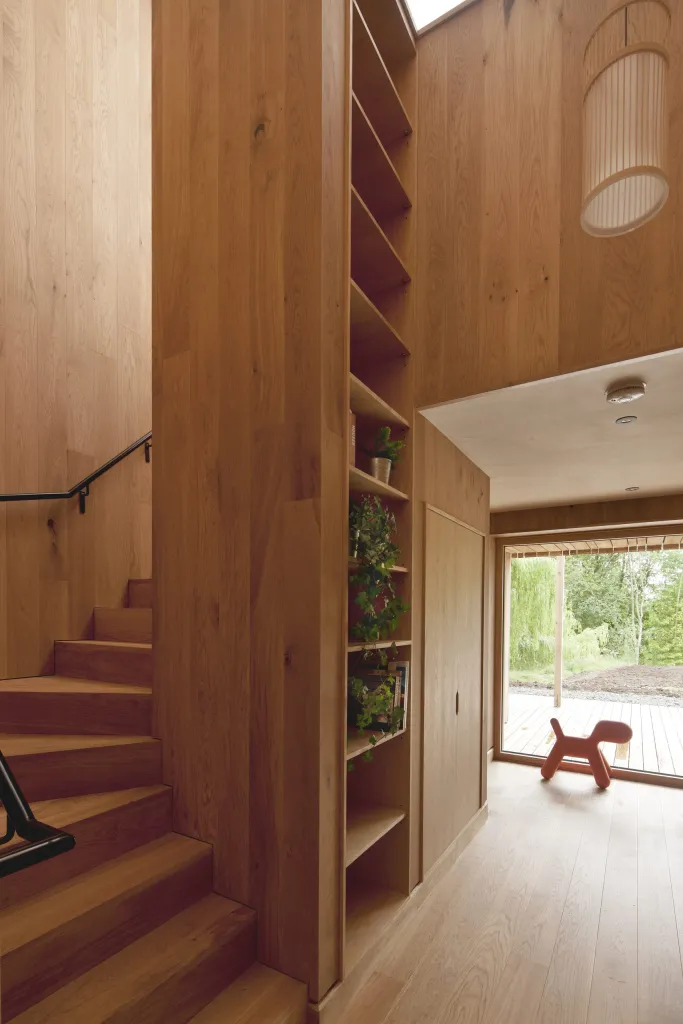
"The Seed" project, located in a woodland garden near Dundee, Scotland, is a co-living home that replaced a derelict building. It was designed from the foundation up to meet extremely high sustainability targets, utilizing almost entirely low-impact, reused, and recycled materials.

Hero Materials

Off-site Timber Frame: The structure uses timber I-joists manufactured off-site, which allows for precision and rapid assembly while utilizing locally sourced, renewable Scottish timber.

Recycled Cellulose and Wood Fibre: The building is heavily insulated with recycled cellulose and breathable wood fibre. This natural fibre insulation provides both excellent thermal performance and significant carbon savings.

Steel Screw Pile Foundations: A unique choice to protect the surrounding protected woodland. This approach avoids the high $\text{CO}_2$ emissions associated with traditional concrete foundations.

Sustainability Highlights

Dual Carbon Targets Achieved: The home achieved both the rigorous Passivhaus Classic certification for operational efficiency and met the strict RIBA 2030 embodied carbon targets. Its measured energy use intensity (EUI) is exceptionally low at $23 \text{ kWh/m}^2/\text{a}$.

Circular Economy Focus: A core principle was waste reduction. Instead of demolition, most components of the old structure were salvaged for reuse or recycling in the new build. This, along with the use of recycled insulation, exemplifies a circular economy approach.

Site-Sensitive Design: The use of steel screw pile foundations was a deliberate choice to ensure the sensitive root systems of the surrounding mature trees were protected, minimizing impact on the protected woodland environment.

Project Team

  • Architects/Passivhaus Consultants: Kirsty Maguire Architect

  • Client: Private clients

  • Contractor: Alpha Projects

  • Structural Engineer: Narro Associates

  • M&E Design: Max Fordham

  • Timber Frame Supplier: Eden Insulation

  • Certifier: Ingo Theobalt (Passivhaus Certifier)

Source

https://asbp.org.uk/case-studies/the-seed

Category

Exterior/Structure


Subcategory

Timber/Hemp


Product Name

Prefabricated Timber Panels with Hempcrete Infill

HPD

SDS

Declare

EPD

LEC

Category

Insulation


Subcategory

Natural Fibre


Product Name

Hempcrete

HPD

SDS

Declare

EPD

LEC

Featured Stuffs

Suggested

Related Stories

More articles you may find useful, carefully selected from our journal
Suggested

Related Stories

More articles you may find useful, carefully selected from our journal
Suggested

Related Stories

More articles you may find useful, carefully selected from our journal
Free 20-min intro call

Tell us what you’re building

Work with a team that brings clarity, care, and creativity to every project.

Free 20-min intro call

Tell us what you’re building

Work with a team that brings clarity, care, and creativity to every project.

Free 20-min intro call

Tell us what you’re building

Work with a team that brings clarity, care, and creativity to every project.

Better stuff. Better design. Better future.


Copyright © 2025 BuildBetterStuff.

All rights reserved.

Better stuff. Better design. Better future.


Copyright © 2025 BuildBetterStuff.

All rights reserved.