Research/ Residential
Recyclable Private Home Crafted in Solid Cork Blocks
Cork House
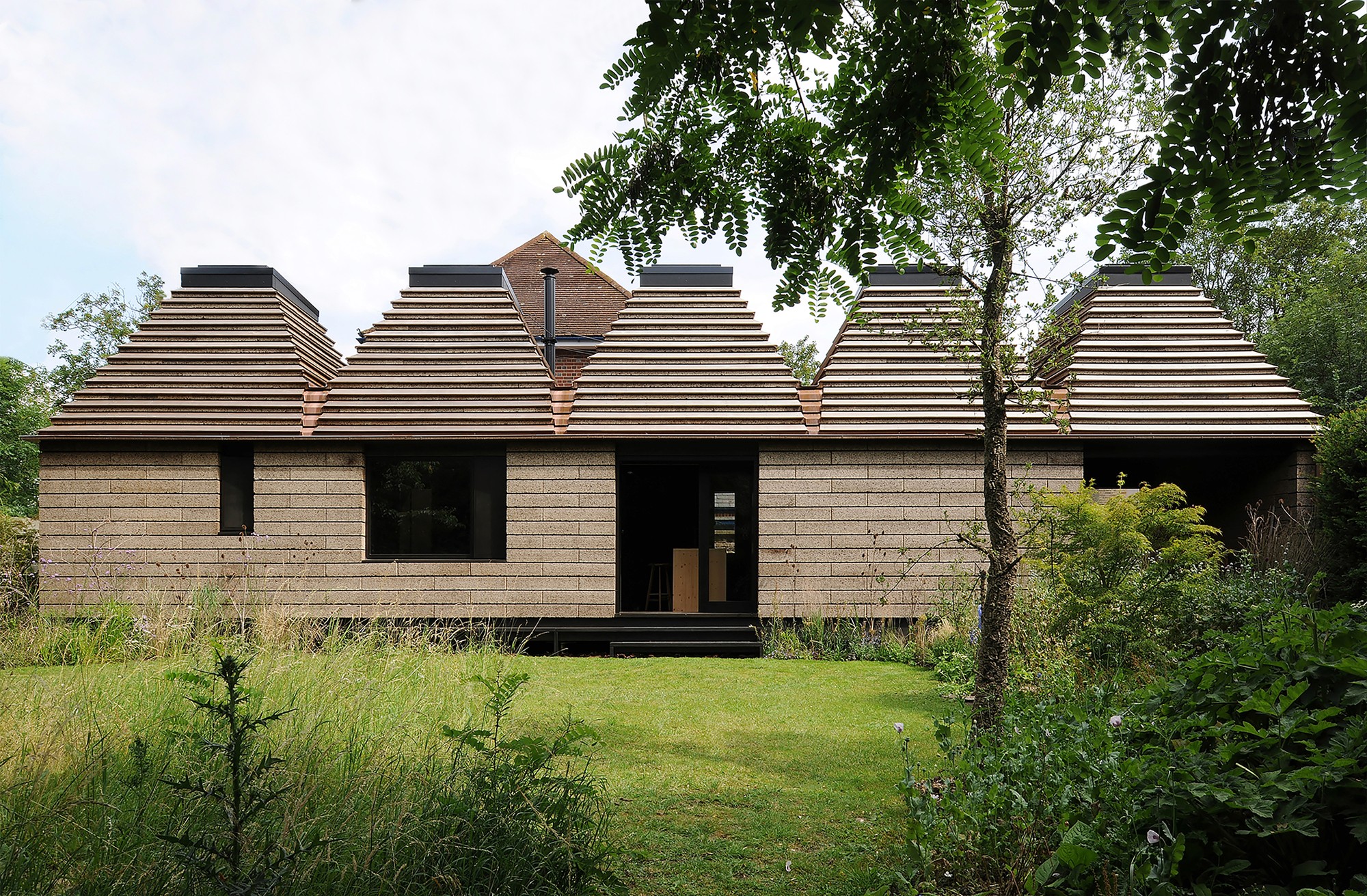
Image Credit: Ricky Jones
Embodied Carbon: Whole-life carbon (BS EN 15978) 619 kgCO₂e/m² over 60 years
Design Life: 60 years
End of Life: Dry-jointed construction enables all 1,268 cork blocks to be dismantled and reused, recycled, or returned to the biosphere.
Construction Process: CNC-machined expanded cork blocks prefabricated off-site and assembled by hand on site as a dry-jointed kit-of-parts
“What if we could replace the complexity of the wall with a single, solid, bio-renewable material?” asked Barnett Howland.
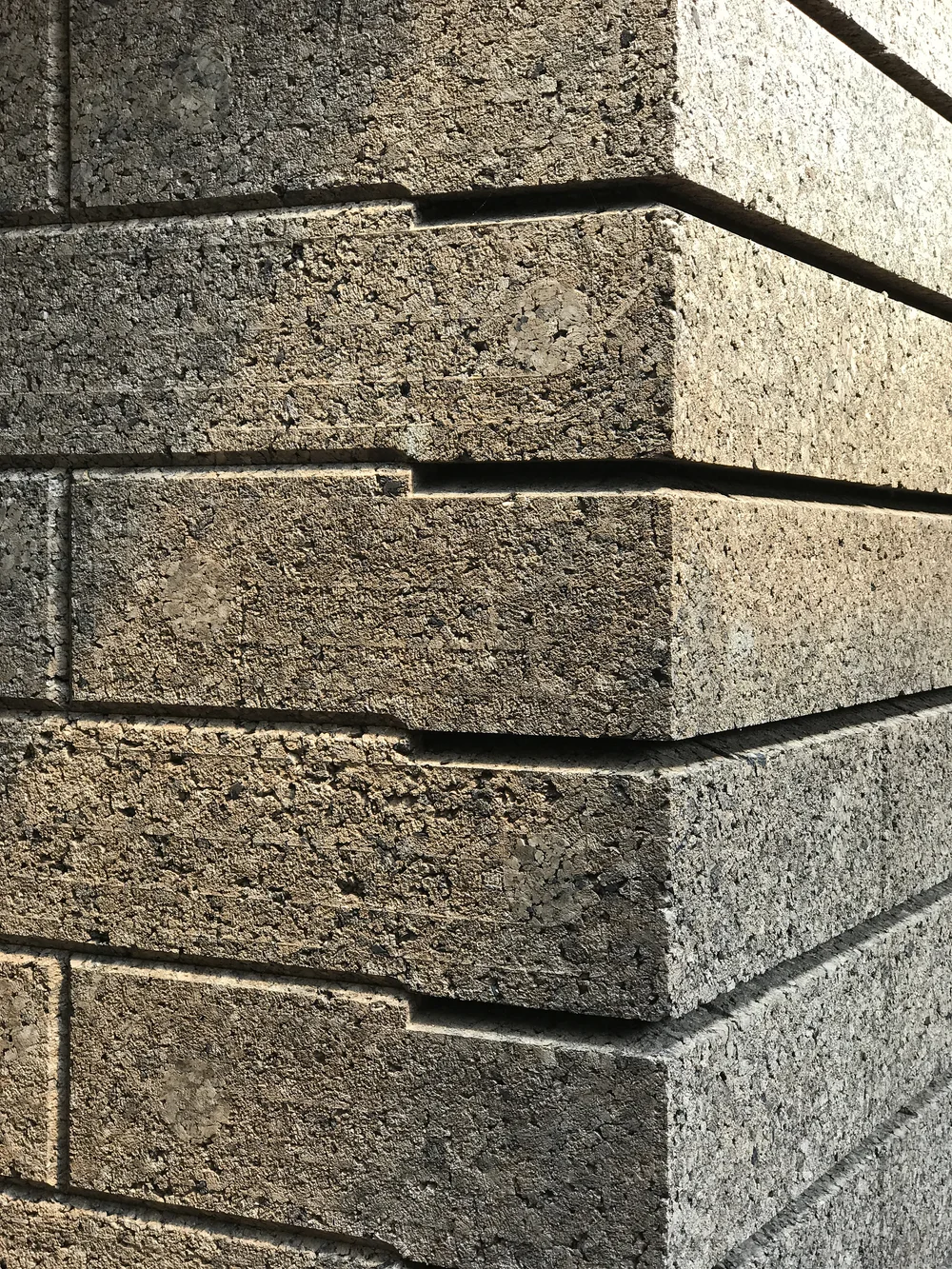
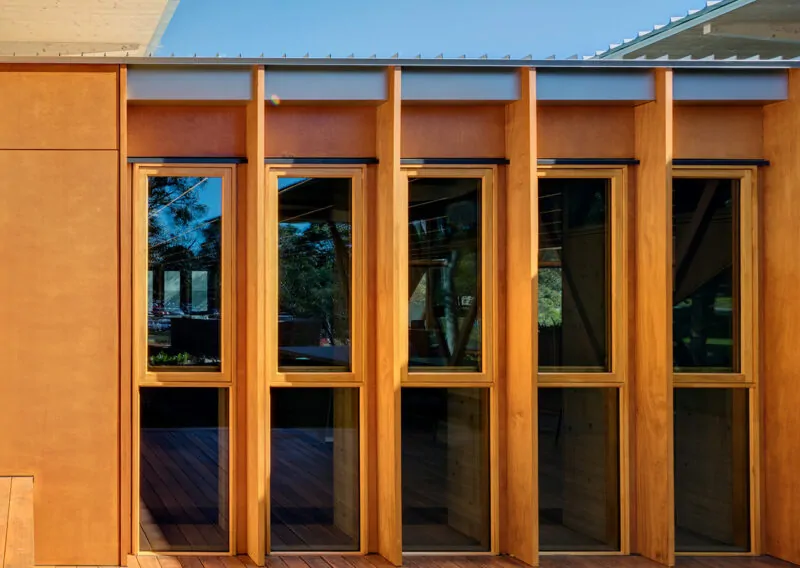
Cork House is a low-rise residential prototype completed in 2019 that explores whether the complexity of contemporary wall construction can be replaced by a single, solid bio-renewable material. Designed by Matthew Barnett Howland, Dido Milne and Oliver Wilton, the project builds on several years of research into the Cork Construction Kit developed in collaboration with UCL. Expanded cork blocks manufactured from forestry by-products form both the primary structure and building envelope. The blocks are CNC-milled and assembled using dry joints without adhesives, creating a prefabricated kit-of-parts system that can be dismantled and reused. Lightweight cork units were installed by hand using simple jigs and tension straps, while complementary components including engineered timber elements, bespoke timber windows and doors were prefabricated off site. The structure sits on removable steel screw pile foundations and CLT decks, enabling minimal ground disturbance and full reversibility. By replacing multi-layered envelope assemblies with a mono-material system that stores carbon, Cork House demonstrates how architectural form, structural logic and material performance can be aligned through simplicity while supporting a whole-life approach to low-carbon construction.
“What if we could replace the complexity of the wall with a single, solid, bio-renewable material?” asked Barnett Howland.
Cork House is a low-rise residential prototype completed in 2019 that explores whether the complexity of contemporary wall construction can be replaced by a single, solid bio-renewable material. Designed by Matthew Barnett Howland, Dido Milne and Oliver Wilton, the project builds on several years of research into the Cork Construction Kit developed in collaboration with UCL. Expanded cork blocks manufactured from forestry by-products form both the primary structure and building envelope. The blocks are CNC-milled and assembled using dry joints without adhesives, creating a prefabricated kit-of-parts system that can be dismantled and reused. Lightweight cork units were installed by hand using simple jigs and tension straps, while complementary components including engineered timber elements, bespoke timber windows and doors were prefabricated off site. The structure sits on removable steel screw pile foundations and CLT decks, enabling minimal ground disturbance and full reversibility. By replacing multi-layered envelope assemblies with a mono-material system that stores carbon, Cork House demonstrates how architectural form, structural logic and material performance can be aligned through simplicity while supporting a whole-life approach to low-carbon construction.
Mono-material envelope: Load-bearing expanded cork blocks integrate structure, insulation and interior finish, reducing layered construction complexity and enabling a single bio-based envelope system.
Dry-joint assembly: Interlocking cork blocks are assembled without mortar, adhesives or fixings, allowing manual construction and full recovery of materials at end of life.
Kit-of-parts construction: CNC-machined blocks and timber components are prefabricated off-site, creating a modular building system that simplifies on-site assembly and enables replicable construction.
Corbelled roof structure: Pyramidal cork roofs use corbelled geometry derived from historic masonry precedents to achieve structural stability using compressive solid material.
Whole-life carbon strategy: Biogenic cork stores atmospheric carbon while eliminating cement, synthetic insulation and composite assemblies that typically increase embodied carbon and hinder reuse.
Mono-material envelope: Load-bearing expanded cork blocks integrate structure, insulation and interior finish, reducing layered construction complexity and enabling a single bio-based envelope system.
Dry-joint assembly: Interlocking cork blocks are assembled without mortar, adhesives or fixings, allowing manual construction and full recovery of materials at end of life.
Kit-of-parts construction: CNC-machined blocks and timber components are prefabricated off-site, creating a modular building system that simplifies on-site assembly and enables replicable construction.
Corbelled roof structure: Pyramidal cork roofs use corbelled geometry derived from historic masonry precedents to achieve structural stability using compressive solid material.
Whole-life carbon strategy: Biogenic cork stores atmospheric carbon while eliminating cement, synthetic insulation and composite assemblies that typically increase embodied carbon and hinder reuse.
Project Team
Location
Year Completed
Project Value
Awards
Sources
More Stories
More articles you may find useful, carefully selected from our journal